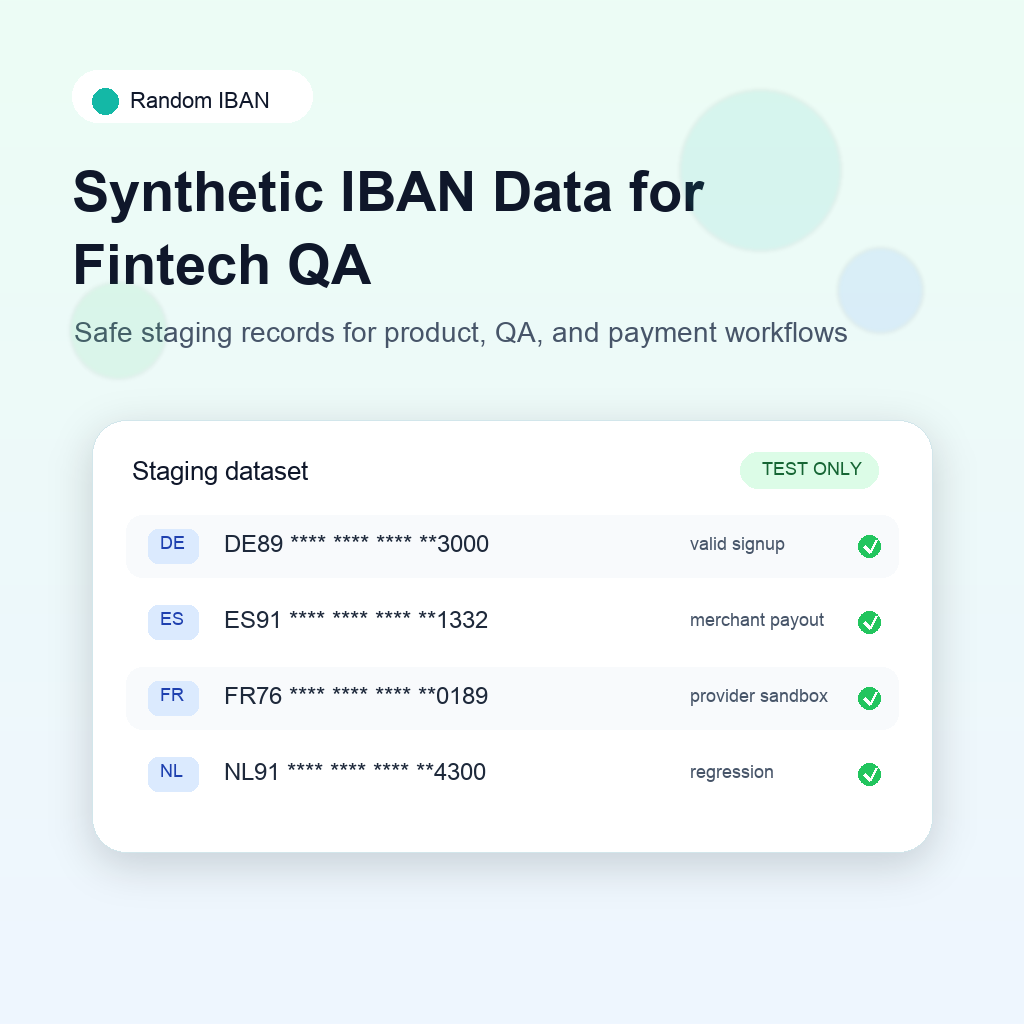
Los equipos fintech suelen necesitar datos de cuentas bancarias realistas mucho antes de que una funcionalidad de pagos llegue a producción. Producto quiere revisar los flujos de alta, QA necesita casos repetibles, desarrollo necesita fixtures para APIs, formularios y procesos en segundo plano, y seguridad y cumplimiento quieren asegurarse de que los datos bancarios reales no se copien a staging.
Los datos IBAN sintéticos resuelven esa tensión. Proporcionan números de cuenta que se parecen y se comportan como IBAN reales para las pruebas, sin depender de registros de clientes reales.
Qué son los datos IBAN sintéticos
Son datos de prueba generados que siguen la estructura real de un IBAN. Pueden incluir el código de país, la longitud, el patrón BBAN y el comportamiento de la suma de comprobación correctos para los países compatibles con el producto.
El objetivo no es simular movimientos de dinero reales, sino hacer que los flujos de producto e ingeniería sean suficientemente realistas para probarlos de forma segura.
Los IBAN sintéticos sirven para:
- Pantallas de alta de cuentas bancarias.
- Flujos de configuración de pagos a vendedores.
- Formularios de perfiles de proveedores y comercios.
- Pruebas de nóminas y tesorería.
- Integraciones sandbox de proveedores de pago.
- Pruebas de regresión de formato, enmascarado y almacenamiento.
- Entornos de demostración para los equipos de ventas o de atención al cliente.
Si el flujo solo necesita un número de cuenta estructuralmente válido, los datos generados suelen ser preferibles a los datos copiados de producción.
Por qué los IBAN reales no deben estar en staging
Copiar datos de cuentas de producción a entornos de desarrollo o QA crea un riesgo evitable. Incluso con acceso limitado, los IBAN reales pueden aparecer en logs, capturas de pantalla, CSV exportados, herramientas de soporte, eventos de analítica, payloads de trabajos fallidos o monitorización de errores.
Una regla sencilla ayuda: los sistemas no productivos deben utilizar datos bancarios no productivos.
Esto facilita la minimización de datos y una separación limpia entre entornos. También permite que ingeniería y QA compartan registros, capturas y errores sin tener que ocultar datos bancarios reales cada vez.
Empieza por los escenarios del producto
Los buenos datos de prueba deben reflejar el funcionamiento del producto. En lugar de usar un único IBAN genérico en todas las cuentas de prueba, crea pequeños grupos de registros sintéticos para los escenarios que admite el equipo.
| Escenario | Qué probar |
|---|---|
| Alta de un cliente | El usuario añade un IBAN por primera vez |
| Configuración de pagos a un comercio | Una empresa guarda una cuenta de liquidación |
| Actualización de cuenta | El usuario sustituye un IBAN existente |
| Revisión manual | Operaciones comprueba datos bancarios enmascarados |
| Fallo del proveedor | Una API sandbox rechaza una cuenta de pagos |
| Lanzamiento multinacional | QA comprueba la longitud y el formato de cada país |
| Importación masiva | Finanzas sube un CSV con muchos beneficiarios |
Así las pruebas quedan conectadas al comportamiento del producto y no solo a la validación técnica.
Usa fixtures estables y valores generados nuevos
Normalmente hacen falta tanto fixtures estables como valores generados nuevos.
Los fixtures estables son útiles para pruebas automatizadas. Un test unitario puede comprobar que una API de alta acepta un IBAN alemán conocido, normaliza los espacios, guarda una presentación enmascarada y devuelve una respuesta predecible.
Los valores nuevos son útiles para pruebas exploratorias. Ayudan a descubrir supuestos sobre longitud por país, mayúsculas, espacios y tamaño de los campos de la base de datos. También sirven cuando QA necesita varios ejemplos del mismo país sin reutilizar el mismo número en cada ejecución.
Un conjunto equilibrado puede incluir:
- Un IBAN válido por cada país incluido en el lanzamiento.
- Ejemplos de IBAN cortos y largos.
- Entradas con espacios que deban normalizarse correctamente.
- Entradas en minúsculas que deban normalizarse a mayúsculas.
- Ejemplos de países no compatibles.
- Valores sandbox del proveedor vinculados a respuestas concretas de éxito o error.
Random IBAN ayuda a generar rápidamente ejemplos por país y después guardar el conjunto elegido en un fichero de fixtures compartido o en una guía de QA.
Mantén sintético el registro completo
Un IBAN realista junto a un perfil de cliente real puede seguir generando confusión. Mantén sintético el registro completo.
Convenciones prácticas:
- Usa nombres de prueba como
QA Merchant Germany. - Usa dominios de correo reservados para pruebas internas.
- Añade metadatos como
environment: stagingosource: synthetic_fixture. - No pongas nombres de clientes reales junto a datos bancarios generados.
- Mantén las cuentas sandbox del proveedor separadas de los fixtures generales.
Esto es importante en demos, capturas, formación de soporte e informes de errores. Un registro claramente sintético es más fácil de compartir y eliminar.
Prueba más allá del campo del formulario
Muchos errores de IBAN aparecen después de la validación inicial. El formulario puede aceptar bien el valor, pero el flujo posterior puede fallar porque el enmascarado, el almacenamiento, las exportaciones o los adaptadores del proveedor lo tratan de otra forma.
Revisa cada lugar donde el IBAN aparece o atraviesa el sistema:
- Formularios de entrada.
- Payloads de peticiones API.
- Registros de base de datos.
- Paneles de administración.
- Herramientas de soporte.
- Plantillas de correo.
- Facturas PDF o informes de pagos.
- Logs de auditoría.
- Webhooks.
- Exportaciones de datos.
Aquí los datos sintéticos son especialmente valiosos. Los testers pueden hacer pasar valores realistas por todo el sistema sin propagar datos de cuentas reales a herramientas secundarias.
Añade controles ligeros
No hace falta un proceso de gobierno pesado para mejorar la seguridad de los datos de prueba. Unos pocos controles prácticos pueden reducir el riesgo rápidamente.
Empieza por estos:
- Prohíbe IBAN reales en entornos locales, de desarrollo, staging y demo.
- Añade cuentas bancarias sintéticas a los datos iniciales.
- Enmascara los IBAN en logs y herramientas internas por defecto.
- Restringe las exportaciones desde sistemas no productivos.
- Revisa capturas y datos de demo antes de compartirlos fuera de la empresa.
- Documenta qué IBAN son sintéticos y dónde se usan.
Son controles lo bastante sencillos para que producto e ingeniería los sigan, pero ayudan a cumplir las expectativas de privacidad y seguridad.
Un flujo práctico
Un flujo limpio de IBAN sintéticos suele ser así:
- Define los países y flujos de pago que admite el producto.
- Genera IBAN realistas para esos países.
- Agrúpalos por escenario de producto, no solo por país.
- Guarda los ejemplos aprobados en un fixture compartido o guía de QA.
- Usa ejemplos nuevos para las pruebas exploratorias.
- Mantén separados los valores sandbox específicos del proveedor.
- Confirma que logs, exportaciones y capturas nunca exponen datos bancarios reales.
Así todos los equipos tienen una fuente común. Producto puede probar el recorrido del cliente, QA reproducir errores, desarrollo automatizar cobertura y cumplimiento comprobar que no hacen falta datos bancarios de producción.
Errores habituales que debes evitar
No construyas todas las pruebas alrededor de un único IBAN conocido. Puede superar las comprobaciones básicas, pero no mostrará problemas de diseño, supuestos por país o almacenamiento.
No trates los datos sandbox del proveedor como datos de prueba universales. Sus ejemplos suelen activar comportamientos sandbox concretos y no sirven necesariamente para todos los flujos.
No introduzcas IBAN sintéticos en registros de clientes que por lo demás son reales. El perfil completo de prueba debe ser sintético, no solo el campo bancario.
No dejes el comportamiento del IBAN para el final de QA. Los datos bancarios afectan al alta, operaciones, finanzas, exportaciones, soporte y notificaciones, por lo que merecen cobertura temprana.
Recursos relacionados
Para ejemplos listos para usar, consulta Números IBAN de prueba para desarrollo. Para planificar QA, usa la Lista de comprobación de pruebas IBAN. Si el equipo trabaja con varios países, compara las estructuras en la guía Formato IBAN por país.
Conclusión
Los datos IBAN sintéticos permiten a los equipos fintech probar flujos relacionados con pagos sin exponer datos bancarios reales. El enfoque más sólido no es una hoja de cálculo llena de números aleatorios, sino una estrategia compartida ligada a escenarios reales del producto, límites claros entre entornos y cobertura de QA repetible.
Usa IBAN generados para acelerar el desarrollo, hacer staging más seguro y acercar las pruebas a los flujos que realmente utilizarán tus clientes.