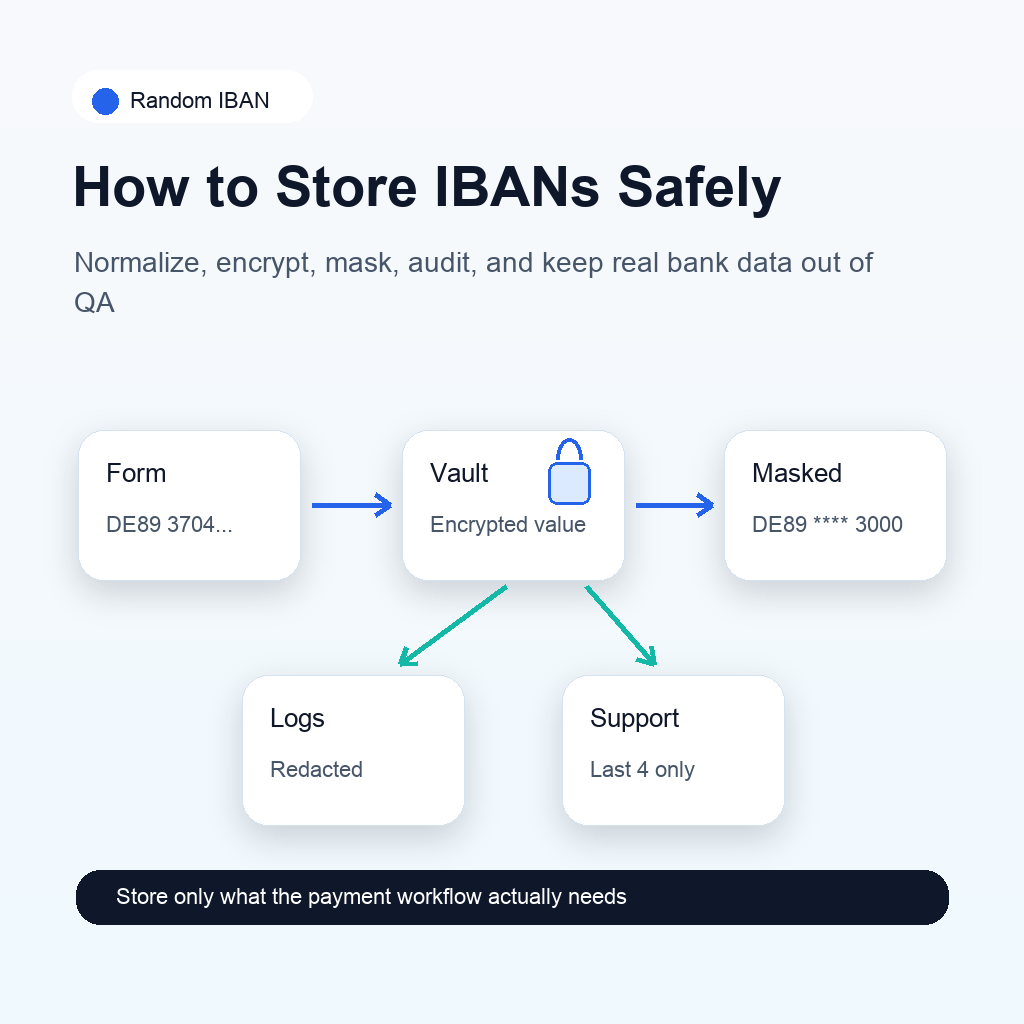
IBANs are not passwords, but they are still sensitive payment data. A real IBAN can identify a bank account, connect that account to a person or business, and appear in payouts, invoices, direct debit mandates, support tickets, exports, and audit trails.
Safe IBAN storage is an engineering design problem. The goal is to collect the value only when the product needs it, normalize it once, validate it server-side, store the minimum useful representation, and keep the raw value away from logs, analytics, and lower environments.
Treat IBANs as Sensitive Financial Data
In most payment products, an IBAN should be treated as personal financial data when it belongs to an individual, and as confidential business banking data when it belongs to a company.
An IBAN alone usually cannot authorize a payment. It does not prove account ownership, and it does not replace a mandate, account verification flow, payout provider check, or fraud review. Still, it can expose banking relationships and create operational risk if leaked.
A practical internal rule is:
- Show the full IBAN only when a user is entering, confirming, or correcting it
- Show a masked IBAN everywhere else
- Store the full IBAN only if future payment execution requires it
- Never use real IBANs in development, demos, screenshots, or analytics events
Start With Data Minimization
Before designing storage, decide whether you need to store the IBAN at all.
You may not need long-term storage if the IBAN is used only for a one-time validation, quote, or temporary setup step. In that case, validate the input, pass it to the payment provider if needed, and discard it after the workflow completes.
You probably do need storage if your product supports recurring payouts, direct debit collection, marketplace seller accounts, payroll, supplier payments, subscription billing, or support workflows that need to identify a saved bank account.
When storage is necessary, separate fields by purpose:
| Field | Purpose |
|---|---|
iban_ciphertext |
Encrypted full IBAN for payment execution |
iban_country |
Routing, filtering, and compliance checks |
iban_last4 |
Safe display and support lookup |
iban_fingerprint |
Duplicate detection without exposing the IBAN |
verification_status |
Tracks ownership or provider checks |
created_at and updated_at |
Audit and retention controls |
Avoid storing formatted display strings as the primary value. Store a canonical version and format it only when rendering.
Normalize Before Storage
IBANs are often entered with spaces, lowercase letters, or inconsistent grouping copied from banking apps. Your system should normalize before validation and storage.
A practical normalization pipeline is:
- Trim leading and trailing whitespace.
- Remove internal spaces.
- Convert letters to uppercase.
- Reject unsupported characters.
- Validate country code, length, and checksum.
- Store the canonical value only after server-side validation.
For example, de89 3704 0044 0532 0130 00 should become DE89370400440532013000.
Keep display formatting separate. A user interface can render the value in readable groups, but downstream providers often expect the compact canonical form.
Encrypt the Full IBAN
If you store full IBANs, use field-level encryption rather than relying only on database disk encryption. Disk encryption helps in some infrastructure scenarios, but it does not protect against many application, backup, analytics, or database access paths.
A safer design encrypts the IBAN before it is written to the database and decrypts it only inside the payment execution path or a tightly controlled operational workflow.
Key points for implementation:
- Use a managed key service when available
- Rotate keys through a planned migration process
- Restrict decryption permissions to services that truly need them
- Keep decryption out of general admin dashboards
- Record every privileged view or export of full bank account data
If engineers, analysts, and support staff can query full IBANs casually, the encryption design is not doing enough.
Use Fingerprints for Lookup
Many systems need to detect whether the same IBAN has already been added. Do not solve this by storing a plain hash of the IBAN.
IBANs follow known country formats, and parts of the value may be structured. A keyed HMAC is a better fit for duplicate detection because it prevents simple precomputed lookup attacks if the database is exposed.
Store a fingerprint such as:
HMAC-SHA256(secret_key, canonical_iban)
Use the fingerprint for equality checks, duplicate prevention, and internal matching. Keep the HMAC key separate from the database and rotate it carefully, because changing it will change every fingerprint.
Mask IBANs Consistently
Masking should be a shared utility, not one-off string logic scattered across the codebase.
A common display pattern is to show the country code and last four characters:
DE89 **** **** **** **3000
Another privacy-focused pattern is:
DE****************3000
Choose one pattern and use it everywhere: customer dashboards, invoices, admin views, logs, email templates, exports, and support tooling.
Do not reveal extra middle digits because they seem harmless. Partial disclosure adds up when the same account appears across multiple systems.
Keep IBANs Out of Logs and Analytics
Log leakage is one of the most common ways payment data escapes the intended boundary. IBANs can appear in request bodies, validation errors, provider payloads, webhook traces, background job arguments, search indexes, and analytics properties.
Build redaction into the platform layer:
- Redact fields named
iban,account_number,bank_account, and provider-specific equivalents - Redact before logs leave the application process
- Redact failed validation payloads as carefully as successful ones
- Disable full request logging on payment routes
- Review error monitoring tools for captured local variables and breadcrumbs
A useful test is to submit a known fake IBAN through staging, then search logs, traces, analytics events, and support tools for the full value. The full IBAN should not appear anywhere outside the encrypted storage path and the required provider request.
Separate Validation From Account Ownership
A valid IBAN is not the same as an owned bank account.
IBAN validation confirms that the format and checksum are plausible. It does not confirm that the account exists, accepts the payment type, belongs to the user, or is safe for payouts.
Depending on the risk level of your product, account ownership may require one or more of these controls:
- Payment provider account verification
- Open banking verification
- Microdeposit confirmation
- Direct debit mandate confirmation
- Name matching where supported
- Manual finance review for high-value payouts
Store this as a separate status. Do not overload iban_valid to mean account verified, payable, and approved.
Design Safe Support Workflows
Support teams often need to identify a bank account without seeing the full IBAN. Give them tools that work with masked data.
Good support workflows allow agents to search by customer, payment reference, country, last four characters, and verification status. Full IBAN reveal should be rare, permissioned, time-limited, and audited.
A practical reveal flow includes:
- A named reason for access
- Permission for sensitive cases
- Automatic masking after a short timeout
- Audit records showing who viewed the value and when
- Alerts for bulk access or unusual viewing patterns
This keeps support effective without turning every admin screen into a data exposure risk.
Use Generated IBANs in Development and QA
Development and staging environments should not contain real customer IBANs. Production database copies are risky because payment data tends to spread into backups, search tools, local machines, screenshots, and debugging sessions.
Use generated test IBANs instead. A valid-format test IBAN is enough for form validation, UI testing, unit tests, CSV exports, webhook simulations, and most provider sandbox flows.
Random IBAN can generate country-specific IBANs that pass standard checksum validation, which makes it useful for:
- Payment form testing
- Demo accounts
- QA scripts
- Seed data
- Documentation screenshots
- Regression tests for masking and redaction
Make test data obvious. Use fake customer names, sandbox provider accounts, and non-production metadata so nobody mistakes a generated IBAN for a real account.
Set Retention Rules
Payment teams often keep bank account data longer than needed because no one owns deletion. Define retention rules when the feature is built.
Consider deleting or archiving full IBAN data when:
- The user removes the bank account
- A seller, supplier, or employee account is closed
- A mandate expires
- The business no longer needs payout capability
- A legal retention period has passed
- A user requests erasure and no overriding obligation applies
Retention is easier when display fields, fingerprints, audit records, and encrypted raw values are separated. You may be able to keep a masked payment history while deleting the full IBAN needed for future transactions.
Engineering Checklist
Before shipping an IBAN collection or storage feature, confirm that:
- The product has a clear reason to store the full IBAN
- Input is normalized before validation
- Validation runs on the server, not only in the browser
- The canonical IBAN is encrypted at field level
- Masked display uses one shared utility
- Logs, traces, analytics, and error reports redact IBAN fields
- Duplicate detection uses a keyed fingerprint
- Full IBAN access is permissioned and audited
- Development and staging use generated test IBANs
- Retention and deletion rules are documented
For validation details, see How to Validate an IBAN Number. For safe QA data, see Synthetic IBAN Data for Fintech QA.
A well-designed IBAN system is not just one that accepts the right format. It is one that limits who can see bank data, keeps real accounts out of non-production environments, and gives payment operations enough information to work without exposing more than they need.